


Who may be considered?
- Those who are planned to have limited form, proportion or color arrangement of their front teeth
- Suitable cases with sufficient healthy enamel tissue
- Fractures, wear or gaps that need to be evaluated with ceramic restoration
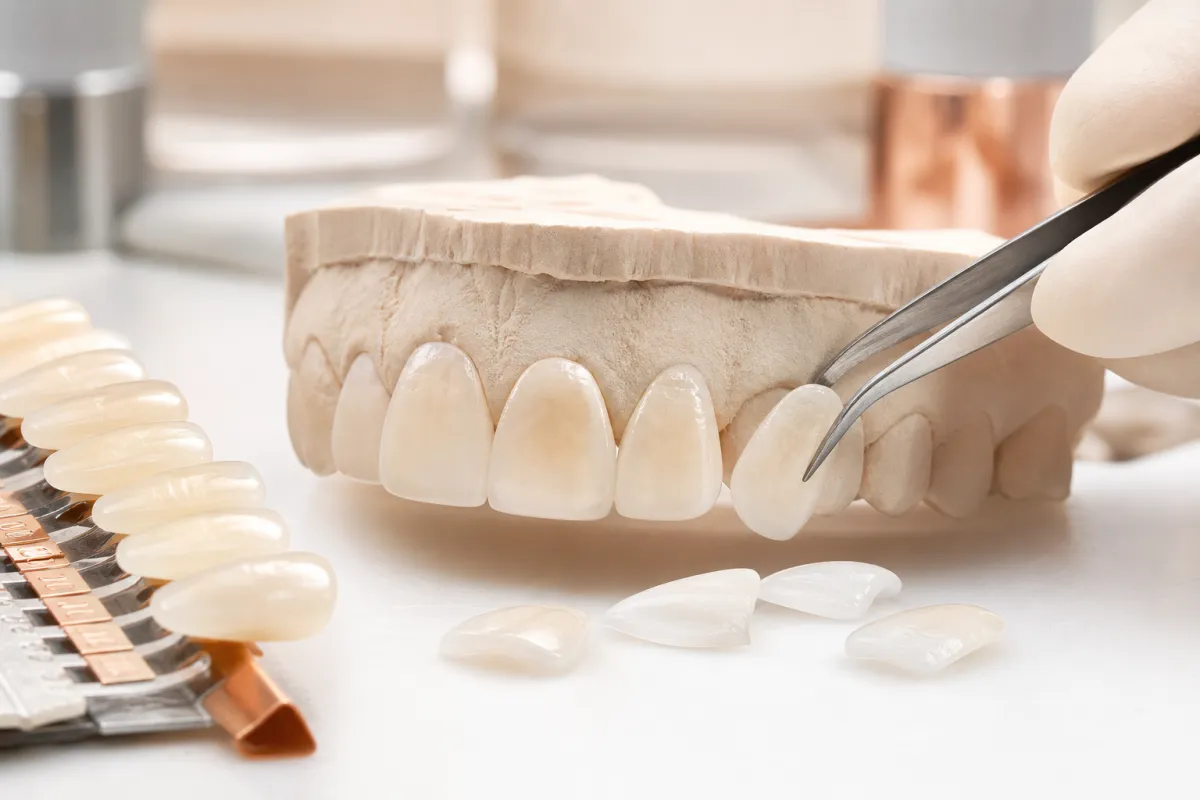
Lithium disilicate and thin ceramic veneer options planned with the aim of protecting tooth structure in aesthetic treatment of the anterior region.
Book an appointmentE-max is a commonly used expression for lithium disilicate-based glass-ceramic restorations. Laminate veneer, on the other hand, describes a thin ceramic restoration that is mostly attached to the visible surface of the front teeth. These two concepts are not the same; Laminate veneers can be produced from lithium disilicate, but not every E-max restoration is veneered. Suitability; It is evaluated according to the amount of enamel, tooth position, color change, occlusion, clenching and targeted form change. Avoiding unnecessary tissue loss is the basic approach.
Evaluation of smile, gums, enamel tissue and bite
Taking photographs, measurements and color records
Preparation of digital design and mock-up if necessary
Determination of minimal preparation or no preparation option on a case by case basis
Adhesive application after the try-in, color and occlusal checks
It is recommended to avoid breaking hard objects with the front teeth, to clean between the teeth regularly and to keep check-up appointments. If there is teeth clenching or grinding, night guards may be planned.
The appropriate method is selected according to clinical findings and individual needs.
It is a thin ceramic restoration that is attached to the front surface of the tooth.
It is a full ceramic restoration that covers the tooth more extensively and has different indications.
It can only be evaluated with appropriate tooth position and volume needs.
The amount of enamel and occlusion are important for the success of the adhesive. In cases with very dark discoloration, severe crowding, insufficient tissue, or a high risk of fracture, other options may be more appropriate.
Composite bonding, whitening, orthodontics, zirconium or treatment-free follow-up; can be compared according to clinical need.
E-max refers to a ceramic material group, and laminate veneer refers to the form of restoration. A laminate veneer can be produced from E-max material.
The amount of preparation varies by case. The goal is to preserve intact tissue as clinical necessity allows.